
The Biological Journey of High-Polyphenol Olive Oil
From the throat sting of oleocanthal to the vagus nerve, the COX enzymes, the gut, and Nrf2 — what happens in the minutes after a single drop. Not oil. A relationship with the nervous system.
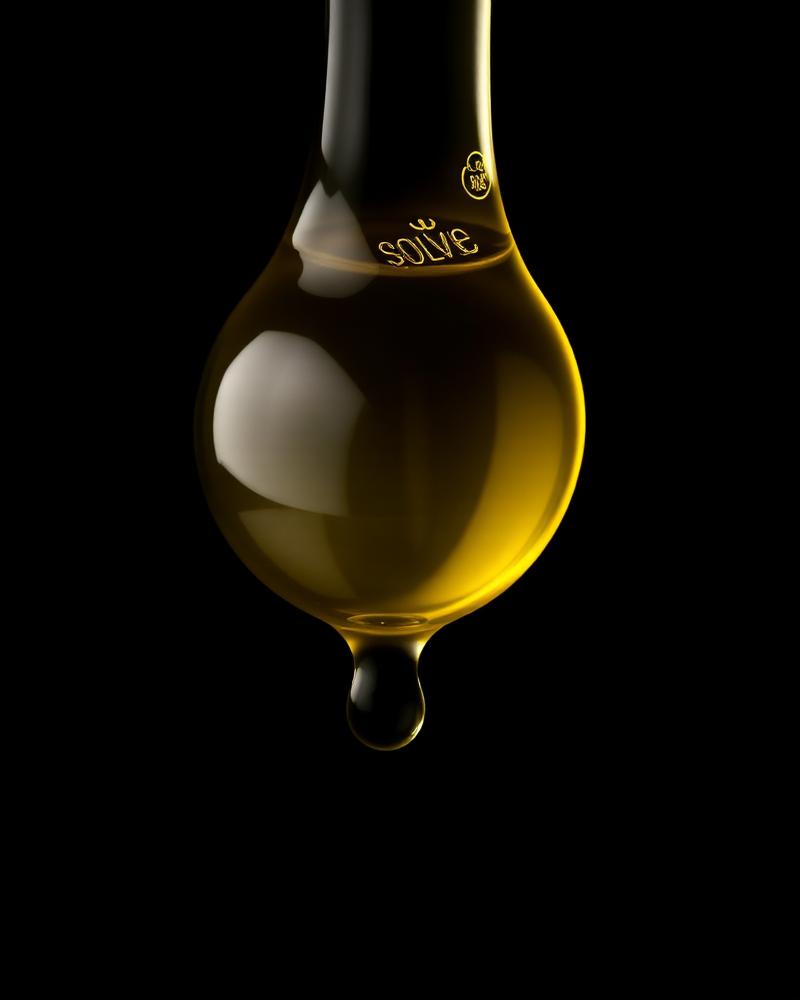
This is why high-polyphenol olive oil is not just food. It is a biotechnic tool. It interacts with the body at the level of receptors, enzymes, genes, and neural pathways.
Six phases. One pathway. This is what happens, chemically, between the throat and the nervous system — and each step is traceable to a peer-reviewed paper.
The Six Phases
The Inhale
Before the oil reaches the mouth, its volatile compounds reach the nose. Green, peppery, grassy — the aroma of fresh-pressed oil is itself a signal. Olfactory receptors send information straight to the limbic system, the part of the brain that governs memory, emotion, and the autonomic nervous system. The body begins to anticipate digestion. This is not a flourish; it is preparation.
The Throat Sting
You swallow. Oleocanthal — the secoiridoid that gives quality oil its burn — hits the TRPA1 receptors concentrated at the back of the throat[2]. This is the sting the trade calls the cough. It is felt almost exclusively in the throat, not the tongue, because that is where the receptor is expressed. The receptors fire, and the signal travels the vagus nerve — the main cable of the parasympathetic system, responsible for rest, digest, and repair[7]. The burn is not a side effect. It is the mechanism announcing itself.
Into the Bloodstream
Oleocanthal and its sister secoiridoids — oleacein, oleuropein, ligstroside aglycones — are absorbed across the intestinal wall and into the bloodstream, where hydroxytyrosol and tyrosol become the metabolites the body actually circulates. A drop of high-polyphenol oil is not a drop of fat. It is a dose of active compounds, the chemistry a tree built under stress, now in transit toward the cells that need it[3][4].
The Ibuprofen Effect
In the bloodstream, oleocanthal does something striking: it inhibits the same COX-1 and COX-2 enzymes that ibuprofen does[1]. The 2005 paper that named this effect called it "ibuprofen-like activity in extra-virgin olive oil" — a plant compound, with no pharmaceutical processing, doing the work of a non-steroidal anti-inflammatory. The inflammation pathway is dampened at the source. This is why the throat sting and the systemic anti-inflammatory effect are the same molecule, two stops apart[3].
The Gut & the Axis
The secoiridoids that survive digestion reach the colon, where they feed the bacteria that produce short-chain fatty acids — butyrate among them. A 2024 review traced virgin olive oil's neuromodulatory effects to changes in the gut microbiota, placing the oil squarely on the microbiota–gut–brain axis[10]. EVOO consumption has been shown to influence vagal activation through its anti-inflammatory polyphenols and the vagal inflammatory reflex[9]. The gut and the brain are not separate systems here; they are two ends of one wire.
Nrf2, NF-κB & the Signal of Safety
At the cellular level, the polyphenols modulate two master switches at once: Nrf2, the pathway that switches on the body's own antioxidant defences[5][6], and NF-κB, the central driver of inflammation[8]. One is turned up. The other is turned down. The net result is a cell that is better defended and less inflamed. The vagus nerve carries the integrated signal to the brainstem — signals of safety, satiety, and calm. Over time, the nervous system settles. This is what re-terroiring looks like in molecular terms[11][12].
The Pathway in Summary
You inhale the aroma. The brain prepares. You swallow. Oleocanthal hits the TRPV1 receptors at the back of your throat. The vagus nerve fires. The parasympathetic system activates. Oleocanthal enters the bloodstream and inhibits COX enzymes. Secoiridoids feed the gut microbiome. Nrf2 and NF-κB are modulated at the cellular level. The brain receives signals of safety, satiety, and calm.
All of this happens in the time it takes to taste a single bottle, or a single drop.
This is what you are selling. Not oil. A relationship with the nervous system. A way of reclaiming sovereign biology. A daily tool for resistance, resilience, and recovery.
The Radical Apothecary.
References
- [1]
Ibuprofen-like activity in extra-virgin olive oil (oleocanthal inhibits COX enzymes)
Nature, 2005
- [2]
Unusual pungency from extra-virgin olive oil is attributable to restricted spatial expression of the receptor of oleocanthal
J Neuroscience, 2011
- [3]
The biological activities of oleocanthal from a molecular perspective
Nutrients, 2018
- [4]
Oleocanthal, a phenolic derived from virgin olive oil: a review of the beneficial effects on inflammatory disease
Int J Mol Sci, 2014
- [5]
Extra virgin olive oil polyphenols: modulation of cellular pathways related to oxidant species and inflammation in aging
Cells, 2020
- [6]
Modulation of Nrf2 by olive oil and wine polyphenols and neuroprotection
Int J Mol Sci, 2016
- [7]
Physiology and immunology of the cholinergic anti-inflammatory pathway (the vagus nerve reflex)
J Clin Invest, 2007
- [8]
Olive polyphenols: antioxidant and anti-inflammatory properties
Antioxidants (MDPI), 2021
- [9]
Effects of EVOO consumption on vagus nerve activation
Aceites Morales, 2025
- [10]
Unveiling the neuroprotective impact of virgin olive oil ingestion via the microbiota–gut–brain axis
RSC, 2024
- [11]
Polyphenols and physical activity stimulate gut-microbiota-mediated Nrf2 signalling to combat neurodegeneration
ScienceDirect, 2026
- [12]
Neuroprotective properties of extra virgin olive oil polyphenols in Alzheimer's disease: a multi-target mechanistic review
Frontiers, 2025
This is not pseudoscience. This is the mechanism.
Sources cited by publication and year. External links will follow as the reference library is vetted.
The sibling pathway
The olive oil pathway is the first route we traced. Its sibling follows the birch sap electrolyte shot — minerals, acetate, and the vagus nerve. Two delivery systems, one nervous system.
The tree builds the medicine under stress. The body receives it and settles. That is the whole transaction.
Para la gente. — The Radical Apothecary.